Change or rekey · Sonya
Gate & Building Entry Locks in Sonya
A visitor buzzes from the panel downstairs, someone presses the button by the door, and nothing happens.
In plain words
Some building entries add a buzzer, a keypad or an electric strike to the mechanical lock, and any one of those pieces can be the reason a door stops releasing on cue. This service checks the wiring, the power supply and the mechanical override together with the lock itself, rather than assuming the fault sits wherever the last person guessed. Whatever combination of electronic and mechanical hardware the entry uses, it leaves working as one system: a mechanical key still able to open it wherever the installed lock provides one, and a fail-safe strike or maglock still releasing on its own if the power ever goes out.
How the visit goesThe driveway gate drags a groove into the gravel every time it swings, and the latch stopped catching weeks ago. Now it sits propped shut with a brick, waiting for anyone to walk through and forget to prop it back.
Gate & Building Entry Locks
How the visit goes
Checking the closer and hinges together
A closer cannot be judged on its own, because a gate that slams or drifts open is often fighting hinges or a post that have moved. The locksmith checks the closer's current adjustment, the condition of its arm and fittings, and then the hinges or pivots the gate hangs from, along with whether the post itself still stands square. Separating a closer problem from a hinge or post problem here avoids replacing a perfectly sound closer that was only ever fighting a leaning post, or the reverse case.
Correcting a frost-heaved or leaning post
When ground movement is the real cause, the fix goes to the post rather than the lock. Depending on what the post is set in, this can mean resetting it plumb, packing or replacing the base it sits in, or adding bracing so it stops drifting with each freeze-thaw cycle. The strike is then repositioned to match the corrected post, and the gate is cycled through several full closes to confirm the latch now meets it consistently, in place of chasing the same misalignment again after the next frost.
An electronic entry tested as one system
Where the entry includes a buzzer, keypad or electric strike, you see it worked before the locksmith leaves: the intercom releasing the door on a buzz, the keypad accepting a code, and, where the installed lock includes one, the mechanical override key turning cleanly as a backup. Batteries or settings that were touched during the visit are confirmed, and, if a backup key exists, you are shown where it lives so it is not lost track of. An entry with both a working backup key and working electronics now has two independent ways to open it, worth keeping in mind the day the power or the app misbehaves.
Gate & Building Entry Locks
In the van
Gate locks and latches
Dry graphite or PTFE lubricant
Keyed-alike cylinders
Corrosion-resistant fasteners
Gate and door closers
Gate & Building Entry Locks
What affects the quote
Any upgrade chosen while the locksmith is already there
Some property owners use the visit to move to a heavier closer, an electric strike, a master key system or additional padlocks for other gates. None of this is required to address the original problem; each option is priced as a separate line.
Whether keys need coordinating across doors
Rekeying a single lock is one task. Bringing several gates or a shared entry onto one common key, or setting up a master key arrangement across a property, adds planning and cylinder work beyond a single rekey.
Access to the gate or entry
A ground-level gate on an easy driveway is straightforward. A shared building entry behind a locked lobby, a gate at the far end of a long property, or awkward scaffolding around the hardware adds time the quote takes into account.
What to have ready
- Is the gate wood, metal, aluminum or vinyl?
- Are there other gates on the property that should share a key?
- Which gate or door is giving you trouble?
Gate & Building Entry Locks: questions
QuestionsHow do you decide whether to repair a gate lock or replace it?
The decision follows what the assessment actually finds rather than the age of the hardware alone. A cylinder that is only stiff or slightly worn is usually serviced and left in place, while one that is pitted, cracked or built to a grade unsuited to its exposure is replaced. The same logic applies to a closer or hinge: adjustment first, replacement only once the part itself has genuinely failed. You are told which category the hardware fell into and why before any work proceeds.
Does this service cover the gate itself, or only the lock?
Both, where the two are connected, which on a gate they usually are. A locksmith working on a gate lock also looks at the hinges, the post and the closer, since a lock rarely fails on its own when the real cause is a sagging gate or a post that has shifted. Work that goes beyond hardware the locksmith carries, such as rebuilding a rotted post or a damaged fence panel, is flagged so it can be handled by whoever normally does that kind of repair.
What actually happens during a gate or building entry lock visit?
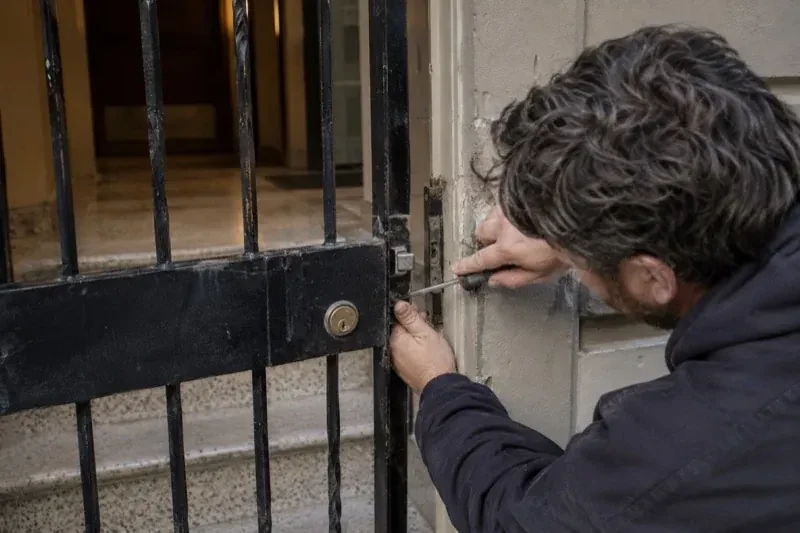
The locksmith first watches the gate or door move and checks the hardware fitted to it, then works out whether the issue sits in the lock, the closer, the hinges or the alignment of the frame itself. Whatever combination is found, the relevant piece is adjusted, rekeyed or replaced, and the whole assembly is cycled repeatedly afterward to confirm it closes, latches and locks the same way every time. Any keys involved are cut and tested before the visit is considered complete.
Related services
- Deadbolt InstallationThe back door has a deadbolt in name only: a short bolt, a thin brass strike held by two little screws, and a jamb you can flex with your palm.
- Lock Replacement & UpgradeThree teenagers, a dog walker, a cleaner and one house key that keeps going missing.
- Vintage Mortise Lock ServiceYou bought a house with its original hardware and a bag of loose keys.